Bedding · Materials · Standards
What GOTS Certification Tells You About Organic Linen Bedding
A label can offer a useful trail through a textile’s long journey—from flax field to finished sheet. GOTS certification helps describe parts of that journey, including organic fiber content and certain processing practices. But it is not a complete account of a product’s environmental footprint. To understand organic linen bedding, look at the certificate and the details around it.
A sheet begins far from the bed
At first glance, bedding seems like a simple object: a rectangle of fabric fitted to a mattress, laundered, folded, and used night after night. Its history is less simple. Linen begins as flax, a plant cultivated for its stem fibers. Those fibers must be separated and prepared, spun into yarn, woven into cloth, and finished before they become a sheet. Each stage involves decisions about materials, facilities, energy, water, chemicals, labor, and transport.
That chain is difficult for a shopper to inspect personally. A certification can make some of it more visible. The Global Organic Textile Standard, commonly known as GOTS, is an international standard for textiles made with organic fibers. It sets requirements that reach beyond the farm and into textile processing and manufacturing. For bedding shoppers, it can be a helpful way to ask more precise questions about what the word “organic” means on a product page.
It is important, though, to read the label as evidence within a defined scope—not as a promise that every environmental or social concern has been resolved. Certification can tell you that specified criteria were assessed through a formal system. It cannot, by itself, answer every question about a particular item’s durability, transport footprint, washing impacts, or the conditions at every point in a complex global supply chain.
What GOTS is designed to address
GOTS was developed to provide a shared framework for organic textiles. Its scope includes the use of organic fibers and requirements for processing, manufacturing, packaging, labeling, and other stages covered by the standard. Rather than treating “organic” as a claim that applies only to a field, the standard considers how a textile is handled as it becomes a finished product.
That distinction matters. A fiber may be grown according to organic agricultural requirements, but the material will pass through further operations before it reaches a bedroom. A textile standard can establish criteria for certain processing inputs and procedures, as well as environmental management and worker-related requirements within its scope. The details are set out in the standard and its current implementation rules, and the specific claim permitted on a product depends on the applicable certification and labeling requirements.
GOTS also uses chain-of-custody controls. In broad terms, certified operators and transactions are documented so that eligible material can be traced through the covered stages. This is different from a casual assertion that a product contains a natural fiber. It is a structured system that relies on certification bodies, records, and checks. Still, a shopper should not assume that one logo explains every component or every process. The exact scope depends on the certified entities, product, and claim.
When a label uses the word “organic,” ask what it refers to. Is the claim about the fiber? The finished textile? A product line? The answer should be clear in the certification information or supporting documentation. The GOTS label and permitted wording are governed by the standard; a retailer’s short description may not provide the full context.
Organic flax is not the whole story
Linen is made from flax, but the name of a fiber does not tell you how it was grown. Nor does “natural” automatically mean “organic.” Organic certification concerns agricultural practices and the requirements that apply to eligible fiber. GOTS then addresses specified stages of textile processing and manufacturing for certified products. These are related ideas, but they are not interchangeable.
When comparing linen sheets, look for the stated fiber composition and the certification claim together. If a product description says it is made from 100% organic flax and is GOTS certified, those are meaningful details to verify against the product’s certification information. If it says “organic linen” without naming a standard or explaining the scope, treat that as a prompt to seek clarification rather than as a complete account.
Fiber content also matters because bedding can contain more than its main fabric. Thread, elastic, labels, decorative stitching, or other components may be subject to different requirements or exceptions under a standard. Product information should distinguish the textile’s principal fiber from other materials when those details are relevant. A certification mark is not a substitute for reading the composition statement.
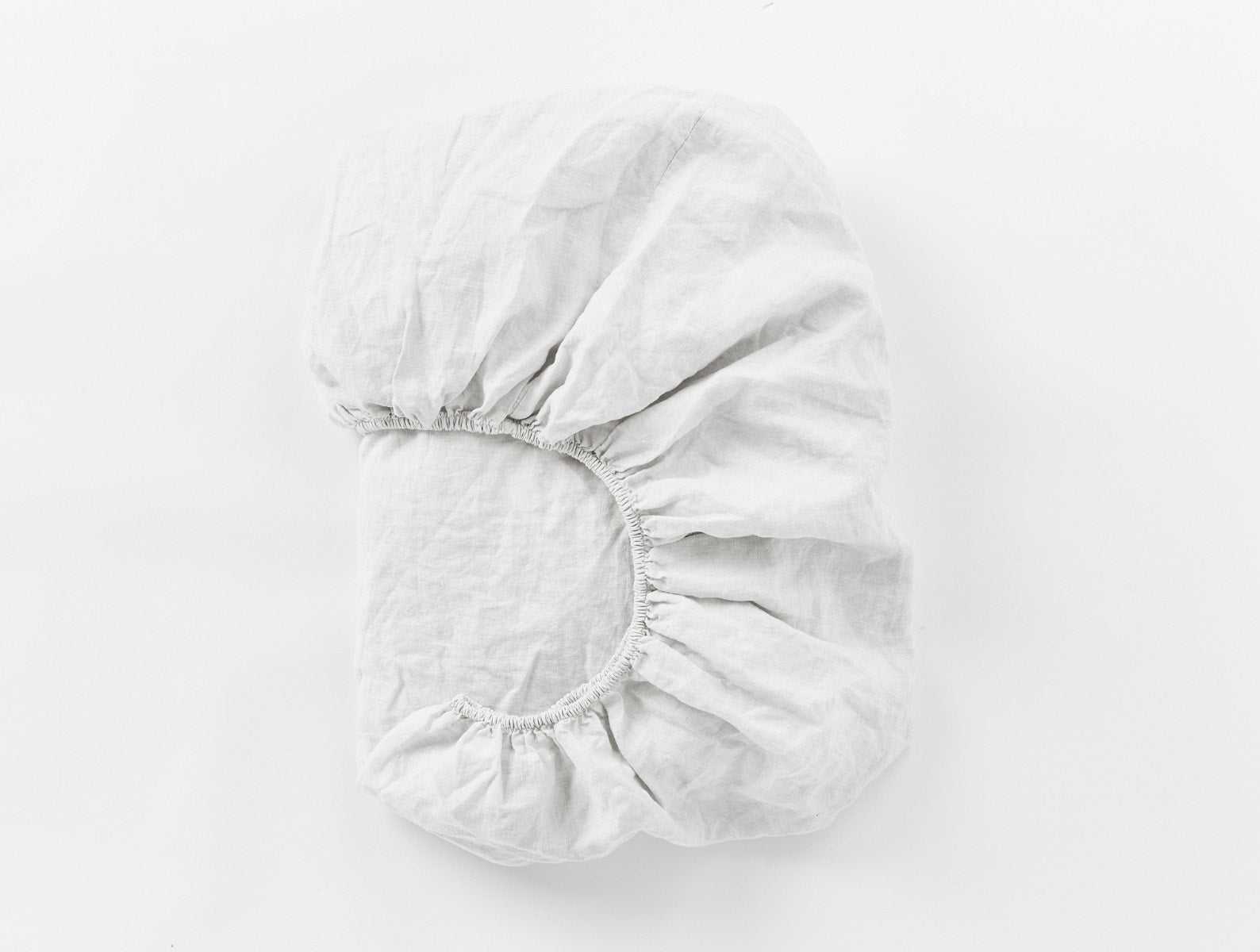
One example in the bedding range is the Coyuchi Organic Relaxed Linen Fitted Sheet. Its product information identifies the material as 100% organic flax, says the flax is grown in France and the linen woven in Portugal, and states that the item is GOTS certified. It also describes a 15-inch-deep pocket, full elastic, and pick-stitched cuffs. Those are useful, distinct pieces of information: certification, fiber origin, weaving location, construction, and fit each answer a different question.
For a specific purchase, shoppers who need assurance beyond the product description can ask the seller for the relevant certification details, including the certificate holder or scope information when available. Certification status can change, and a general statement about a brand or collection should not automatically be assumed to apply to every product or component.
The journey from field to finished fabric
Tracing a linen sheet is a little like following a river upstream. A place of origin may identify where the flax was grown, but it does not necessarily identify where it was spun, woven, dyed, finished, sewn, or packed. Those stages may occur in different countries and facilities. Clear product information separates them instead of compressing them into a single vague phrase such as “European linen.”
Origin can be useful for understanding a supply chain, but geography alone does not prove environmental performance or responsible labor practices. A country-of-origin statement tells you something about location; a certification tells you whether defined requirements were assessed. Neither should be treated as a universal shortcut for the other. Ask which stage a location refers to, and whether the certification covers the relevant operation.
For linen bedding, a careful product description might identify the flax source, the place of weaving, the finished item’s fiber composition, and its certification status. A separate care label explains how to maintain the fabric. This information lets a shopper compare products on facts rather than on atmospheric language alone.
The Coyuchi fitted sheet’s stated French flax origin and Portuguese weaving location, for example, sketch two steps in its route. They do not, on their own, supply a complete lifecycle assessment or describe every facility involved. That is not a flaw in the information; it is a reminder to interpret each detail within its limits.
What certification does not tell you
Organic certification is not a synonym for impact-free production. Growing, processing, dyeing, finishing, and transporting textiles all use resources. Their effects vary by location, technology, energy source, farming practice, and management. GOTS provides a defined framework, but the presence of a certification does not quantify the complete environmental footprint of an individual sheet.
Nor does it tell you how long the bedding will last in your home. Durability depends on fiber quality, yarn and weave construction, sewing, how often the sheets are used, and how they are washed and dried. A well-made item that remains in use for years may offer practical value, but no label can predict exactly how a particular household will care for it or how long it will retain its preferred feel.
Certification should also not be confused with medical assurance. Linen is often described as breathable or comfortable, and some sleepers may find its texture suits them. Those qualities do not establish that a sheet will treat allergies, improve sleep, or prevent irritation. If you have a health concern, consider the full product composition and seek advice from an appropriate health professional rather than relying on a textile label.
Finally, GOTS does not necessarily provide the answer to every labor, animal-welfare, packaging, or transport question a shopper might have. Its requirements cover specified issues in the standard’s scope, but responsible purchasing can involve additional questions. A label is a starting point for inquiry, not a complete moral biography of a product.
Reading product details with care
When you encounter certified organic linen sheets, separate the information into a few practical categories. This makes comparisons more grounded and helps prevent one appealing claim from standing in for many different facts.
- Fiber: Check whether the textile is described as 100% linen, a blend, or a different fiber entirely. Look for the stated organic claim and whether certification is named.
- Certification: Note whether the product is identified as GOTS certified and whether the seller provides current, product-specific supporting information. Avoid assuming a brand-level statement covers every item.
- Supply-chain locations: Distinguish where flax was grown from where yarn was made, fabric woven, and the finished product assembled. A single country name may refer to only one stage.
- Construction: Look at fabric weight if supplied, weave or finish, stitching, elastic, pocket depth, and the dimensions of the sheet. These details affect how the item fits and feels.
- Care: Follow the care instructions on the product. Washing temperature, cycle, drying method, and ironing guidance can influence wear and appearance over time.
- Completeness of the claim: Notice what is stated—and what is not. A specific, bounded claim is more useful than broad words such as “green,” “clean,” or “eco-friendly” without supporting detail.
Comparisons are most useful when products are considered on similar terms. For instance, a sheet’s organic fiber claim does not tell you whether its fitted pocket suits a deep mattress. A carefully described weave does not establish the product’s certification. Both kinds of information matter, but they answer different questions.
Fit and care are part of the decision
Certification may help explain how materials and processing are assessed, while practical product specifications help determine whether a sheet will work day to day. A fitted sheet that slips off the mattress or is difficult to launder is unlikely to become a favorite, whatever its label says. Check mattress depth, including any topper, against the listed pocket dimensions. Full elastic can help the sheet stay in place, though mattress shape and fit remain important.
Linen’s tactile character is also different from that of many cotton sheets. It often has a more textured, relaxed surface, and garment washing or other finishing can change its initial hand. Individual preferences vary: one sleeper may enjoy the evolving softness, while another may prefer a smoother or crisper fabric. Product descriptions can help, but where possible, consider return policies and the maker’s explanation of the finish.
Care instructions should be treated as part of the product’s use, not as fine print. The Coyuchi fitted sheet is described with cold, gentle machine washing and low tumble drying, with warm ironing optional. Following the instructions helps avoid unnecessary stress on the fabric and construction. More generally, washing only when needed, using the recommended cycle, and avoiding excessive heat where the care label advises against it can support the useful life of bedding.
Durability is not purely a matter of a fiber’s reputation. Seams, elastic, laundering habits, storage, and frequency of use all contribute. If longevity is a priority, ask whether replacement components are available, whether the seller offers repair guidance, and how the product is intended to be maintained. These questions extend the conversation beyond the moment of purchase.
The larger environmental picture
Textile impact is distributed across a product’s life. Farming practices affect the growing stage; fiber preparation and weaving require equipment and energy; dyeing and finishing involve additional processes; freight moves materials and finished goods; and laundering consumes household resources. End-of-life options depend on the fabric’s composition, condition, local collection systems, and whether it can be reused or recycled.
GOTS can give shoppers a structured way to evaluate certain organic and processing-related claims, but it is not the same as a product-specific lifecycle assessment. Such an assessment would examine multiple impact categories across defined stages and rely on stated methods and data. Without that evidence, it is wiser to avoid declaring one fiber categorically “best” for every place and purpose.
For a household, a useful decision can be modest and concrete: choose a product whose material and certification claims are clearly documented, whose construction suits the bed, and whose care requirements are realistic. Then use and maintain it thoughtfully. Choosing fewer, well-suited items and keeping them in service can matter in practice, though the result depends on how products are made, used, and eventually handled.
Certification is one tool in that process. So are transparency, repair, careful laundering, resale, donation, and responsible disposal where local options exist. None is a universal solution, but together they encourage a more complete view of bedding as a material object with a history before purchase and a life after it.
Questions worth asking before you buy
A shopper does not need to become a textile auditor to make a thoughtful choice. A few focused questions can reveal whether a description offers enough information to assess the product:
- Does the listing state the fiber composition clearly, and does it specify whether the linen is organic?
- Is GOTS certification explicitly identified for the product, with further documentation available if needed?
- Where was the flax grown, and where was the fabric woven or the finished bedding made?
- What are the sheet’s dimensions, fitted-pocket depth, and construction details?
- What care method does the label recommend, and is it practical for your household?
- Are broad sustainability claims supported by specific, verifiable information?
If a seller cannot answer a question, that does not automatically mean a product fails a standard. It may mean the available product page is incomplete. A clear response—or a direct reference to current certification documentation—can help distinguish a substantiated claim from a vague one.
A label is a map, not the territory
GOTS certification can make organic textile claims more legible. It links agricultural fiber requirements with defined rules for stages of processing and manufacturing, supported by certification and documentation. For people comparing organic linen bedding, that framework is useful because it reaches beyond the word “natural” and invites attention to how a textile moves through production.
But the label is not a verdict on every feature of a sheet. It does not replace checking fiber content, origin statements, weave, construction, dimensions, care requirements, or the exact scope of a certification claim. Nor does it calculate the full environmental impact of a product or guarantee that it will suit every sleeper and household.
Read the certification alongside the product details. Ask where the flax was grown and where the linen was woven. Check that a fitted sheet matches the mattress. Understand how it should be washed. In that small act of careful reading, a bed becomes more than a surface for sleep: it becomes a place to notice the decisions—agricultural, industrial, and domestic—woven into everyday life.